

How Investors Evaluate Hotel Investment Properties
1. Understanding Net Operating Income (NOI)
2. What Is CAP Rate?
3. CAP Rate vs ROI
4. Example of Hotel Investment Calculation
5. How to Estimate Property Price When NOI Is Unknown

How Investors Evaluate Hotel Investment Properties
1. Understanding Net Operating Income (NOI)

Net Operating Income, commonly referred to as NOI, represents the income generated by a property after deducting the costs required to operate it.
The basic formula is:
NOI = Total Revenue − Operating Expenses
Operating expenses may include:
- Staff salaries
- Utilities such as electricity and water
- Maintenance and repairs
- Housekeeping and laundry
- Marketing and management costs
- Property tax and insurance
Financing costs, such as bank loan payments, are not included in NOI. This indicator helps investors understand how efficiently the property performs from an operational perspective.
2. What Is CAP Rate?
The Capitalization Rate, or CAP Rate, is one of the most widely used metrics in real estate investment. It measures the expected return of a property based on its income and purchase price.
The formula is:
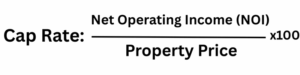
Example:
- Property Price: $1,000,000
- NOI: $80,000 → Cap Rate = 8% → This tells investors how profitable that building is.
Note: CAP Rate allows investors to compare different properties and quickly estimate whether the asking price is reasonable.
Lower CAP Rate vs Higher CAP Rate
| Factor | Lower CAP Rate | Higher CAP Rate |
|---|---|---|
| Investment Risk | Lower risk | Higher risk |
| Location | Usually prime or central locations | Often secondary or less developed areas |
| Income Stability | More stable and predictable income | Income may fluctuate more |
| Property Condition | Often newer or well-maintained properties | May be older buildings or require renovation |
| Investor Expectation | Investors prioritize safety and stability | Investors expect higher return to compensate for risk |
| Potential Return | Lower but more stable return | Higher potential return if the property performs well |
| Typical Investor Type | Institutional investors, conservative investors | Value-add investors, higher risk investors |
In simple terms:
- Lower CAP Rate → Lower risk, more stable income
- Higher CAP Rate → Higher risk, higher potential return
Why Higher CAP Rate Often Means Higher Risk?
A high CAP rate does not always mean the property is performing better. Often it means the property price is lower because investors see more risk.
Example:
| Property | NOI | Price | CAP Rate |
|---|---|---|---|
| 1. Prime building in BKK1 | $100,000 | $2,000,000 | 5% |
| 2. Old building in remote area | $100,000 | $1,200,000 | 8.3% |
Both generate the same income, but:
- The second property is cheaper
- Because investors believe it has higher risk
Possible risks:
- older building
- unstable tenants
- lower demand location
- higher vacancy risk
- maintenance problems
So investors demand higher return → higher CAP rate.
Why Lower CAP Rate Means Lower Risk
A low CAP rate usually means:
- Prime location (BKK1, Tonle Bassac, etc.)
- Stable tenants
- Strong rental demand
- New or well-managed building
Investors feel safer, so they are willing to accept lower return.
Example in Phnom Penh:
| Area | Typical CAP Rate |
|---|---|
| BKK1 Prime area | 5% – 6% |
| Secondary area | 6% – 8% |
| Risky / developing area | 8% – 10%+ |
Important Point
A high CAP rate can come from two situations:
a. High NOI (good performance)
Example:
- Hotel improved management
- Occupancy increased
- Revenue increased
→ CAP rate increases (good reason)
b. Low property price (risk)
Example:
- Investors don’t trust the building
- Market demand is weak
→ CAP rate increases (risk reason)
Market CAP Rate
Each market tends to have a typical CAP Rate range depending on location and property type. Investors often estimate a property’s value by applying the market CAP Rate.
A common valuation approach is:
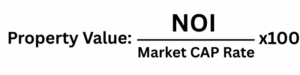
This method helps investors quickly determine whether a property’s price aligns with its income performance.
3. CAP Rate vs ROI
Although CAP Rate and ROI both measure investment returns, they serve different purposes.
| Metric | What It Represents |
| CAP Rate | Performance of the property itself |
| ROI (Return on Investment) | Return based on the investor’s actual cash investment |
CAP Rate assumes the property is purchased entirely with cash and is useful for comparing properties.
ROI, on the other hand, reflects the investor’s financing structure, including bank loans, interest payments, and the amount of capital invested.
In simple terms:
- CAP Rate helps evaluate the property’s income potential.
- ROI shows the return the investor earns from their invested capital.
4. Example of a Hotel Investment Calculation
The following simplified example illustrates how investors estimate hotel performance.
Hotel information:
- Total Rooms: 100 rooms
- Average Room Rate: $50 per night
- Occupancy Rate: 70%
Step 1: Estimate Daily Revenue
100 rooms × 70% occupancy × $50 = $3,500 per day
Step 2: Estimate Annual Revenue
$3,500 × 365 days = $1,277,500 per year
Step 3: Estimate Operating Expenses
Operating expenses for hotels often range between 35% and 50% of revenue. Assuming operating costs represent 40% of revenue:
$1,277,500 × 40% = $511,000
Step 4: Calculate NOI
$1,277,500 − $511,000 = $766,500 (NOI)
Step 5: Estimate CAP Rate
If the hotel is offered for sale at $8,000,000, the CAP Rate would be:
$766,500 ÷ $8,000,000 = 9.6% CAP Rate
This indicates the property could generate approximately 9.6% annual return if purchased entirely with cash.
5. How to Estimate Property Price When NOI Is Unknown
In many cases, especially when evaluating hotels, apartment buildings, or commercial properties, the seller may not provide the exact Net Operating Income (NOI). Investors therefore estimate the property value using market benchmarks and reasonable assumptions.
Here are several common methods used by investors:
a. Estimate NOI Using Market Operating Ratios
If the revenue of the property is known but expenses are not available, investors often estimate operating costs based on typical industry ranges.
For example:
- Hotels: 35% – 50% operating expenses
- Apartments: 25% – 40% operating expenses
Example
Estimated annual revenue: $1,200,000
Estimated operating cost (40%): $1,200,000 × 40% = $480,000
Estimated NOI: $1,200,000 − $480,000 = $720,000
Once the estimated NOI is known, investors can estimate the property price using market CAP rates.
b. Use Market CAP Rate to Estimate Property Value
If the market CAP rate for similar properties is known, investors can estimate the value using the formula:
Example:
Estimated NOI: $720,000
Market CAP Rate: 8%
Estimated property value: $720,000 ÷ 0.08 = $9,000,000
c. Compare With Similar Properties
Another common approach is to compare the property with recently sold or listed buildings in the same area.
Investors review:
- price per room (for hotels)
- price per unit (for apartments)
- price per square meter
- location and building condition
This comparison helps estimate a reasonable market value even when financial data is limited.
d. Estimate Based on Potential Revenue
Some investors estimate the maximum potential revenue of the property and then apply typical expense ratios.
Example for a hotel:
Rooms: 100 rooms
Average rate: $50 per night
Occupancy: 70%
Estimated annual revenue can then be calculated, and typical operating costs deducted to estimate NOI.
Summary
When NOI is not available, investors usually:
- Estimate revenue potential
- Apply typical operating expense ratios
- Calculate an estimated NOI
- Apply the market CAP rate to estimate the property value
Conclusion
Evaluating hotel investments involves more than simply looking at the building itself. Investors carefully analyze financial performance, market conditions, and operational factors to determine whether a property offers strong long-term potential.
Key indicators such as NOI, CAP Rate, ROI, occupancy rate, and market comparisons help investors assess risk, estimate returns, and determine the fair value of a hotel property.
By understanding these principles, investors can make more informed decisions when considering hotel investment opportunities in growing markets such as Phnom Penh.